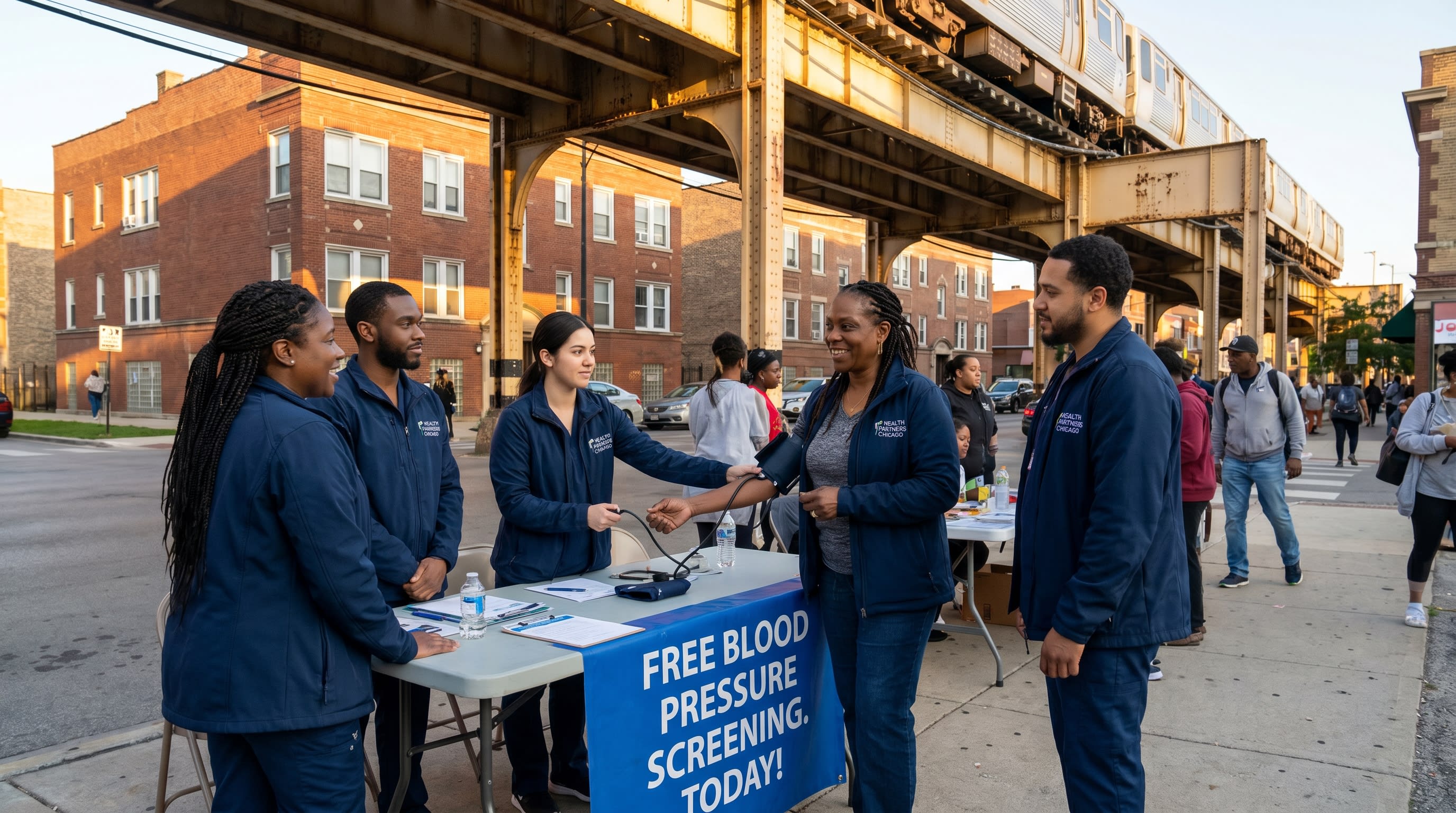
Going Into the Community to Bring Down High BP
When half the people who show up to a community health table are found to have high blood pressure — many for the first time — it tells you something important: the system isn't coming to them. Live Healthy Chicago is changing that.
The American Medical Association recently published a major feature on Live Healthy Chicago, examining how a 31-partner coalition is doing something most health systems have never attempted at scale: going to the community first. Written by senior news writer Georgia Garvey, the piece captures both the data behind Chicago's stark health disparities and the daily human effort to close them.
The approach is direct: bring free blood pressure screenings, community health workers, and evidence-based care into the neighborhoods on Chicago's South and West Sides where hypertension rates are highest — and the existing health system has historically been hardest to reach.
The Numbers Behind the Urgency
These aren't just statistics. Each number represents a person who, under the traditional system, might have gone years without knowing their blood pressure was dangerous — without a primary care provider, without medication, without support. Live Healthy Chicago exists to interrupt that pattern.
The Partnership Behind the Work
Live Healthy Chicago brings together 31 organizations under a shared framework. At the center are two anchor clinical partnerships — each pairing a major health system with a trusted community organization rooted in the neighborhoods they serve:
These aren't transactional relationships. The AMA's investment and the dual health-system partnerships reflect a shared conviction that hypertension on Chicago's South and West Sides is not a clinical problem with a clinical solution — it requires the entire community working together.
Evidence-Based Care: The AMA MAP™ Framework
Live Healthy Chicago's clinical foundation is the AMA MAP™ Hypertension Program — a three-step framework embedded directly into Rush's electronic health records and community workflows. In 2025, updated guidelines from the AMA and American Heart Association raised the urgency further, calling for earlier treatment and wider use of automated measurement.
Use a validated, automated blood pressure cuff — not the traditional wall-mounted version. Have the patient sit quietly for five minutes, feet flat, arm at heart level, and take multiple readings. Accurate measurement is the foundation of everything else: without it, treatments are calibrated to the wrong target.
When blood pressure is elevated, don't wait. Updated 2025 guidelines call for earlier initiation of treatment — including combination medications — rather than the older "watch and wait" approach. The longer blood pressure stays elevated, the greater the cumulative risk of stroke, heart attack, and kidney damage.
Patients are partners, not passengers. The program emphasizes home blood pressure monitoring, shared decision-making, and building a daily routine — checking twice a day, just like brushing your teeth. Community health workers play a key role in teaching home monitoring and ensuring patients feel supported between visits.
Meeting People Where They Are
The most powerful insight from the AMA feature is simple: the existing system isn't designed to reach the people who need it most. Clinic appointments require time, transportation, insurance, and trust — barriers that compound for working families in underserved neighborhoods. Live Healthy Chicago removes them.
Community health workers — trained partners embedded in neighborhoods — bring screenings into faith communities, barbershops, community centers, and sidewalks people already use. No appointment. No waiting room. No parking fee. And when a reading comes back high, they don't just hand over a brochure. They help connect that person to a provider, navigate insurance, and follow up.
"Imagine you're a working person. You have parents who are elderly, kids. You're back and forth commuting. Your blood pressure's up. You don't have that much money. You have to pay $30 for parking. You go in, of course your blood pressure's up in the office, and then they say: 'Come back in a month.' That's no way to treat something like this."
— David Ansell, MD, MPH · Senior VP, Community Health Equity, Rush University Medical SystemDr. Ansell has built his career around one question: why do people in some Chicago neighborhoods live so many fewer years than those just miles away? His answer — and the answer Live Healthy Chicago embeds into every screening and clinic visit — is that physicians must address the social conditions shaping their patients' lives, not just the numbers on a cuff.
Why Every Millimeter Counts
The science is precise about what's at stake. A 5 mm Hg reduction in systolic blood pressure is associated with a 10% reduction in cardiovascular risk. That's not a rounding error — that's a life. Multiplied across 27 priority neighborhoods, consistent blood pressure control has the potential to fundamentally shift how long Chicagoans live.
Patients with hypertension should be checking their blood pressure twice a day, Dr. Ansell notes — and thinking of it as a daily form of health maintenance, like toothbrushing. The goal is to make that possible: to give people the tools, the knowledge, and the support to manage their own health — on their own terms, in their own neighborhood.
Read the Full Feature
Georgia Garvey's complete reporting on Live Healthy Chicago is available on the AMA website — including additional perspectives from physicians and a deeper look at the coalition's clinical framework.
Read on AMA.org